 PetCare
Weight tracking
How to Weigh a Dog at Home, From Tiny to Large
Weighing a dog at home is easy for a chihuahua, awkward for a labrador and impossible for a mastiff on a bathroom scale, but there is a sensible method for each. This guide covers what to use, how to get a reliable number, how to track it and what a change actually means.
Why bother weighing at home
Weight is one of the few health numbers you can check yourself, repeatedly, for free. A slow gain is the usual road to obesity, which shortens lives and stresses joints; a quiet loss can be an early sign of dental, kidney, thyroid, digestive or other disease. A weigh-in once a month, or as your vet advises, also tells you whether the portion you are feeding is right, which is more reliable than the bag's guideline alone. For the broader picture, see pet weight tracking; this guide is about getting the number.
Choose a method by size
| Dog | Best method | Accuracy and notes |
|---|---|---|
| Puppies and toy dogs under about 5 kg | Place on a kitchen or baby scale in a box, bowl or pet carrier; subtract the container. | Most accurate; look for a scale that reads in 1 g or 5 g steps. |
| Small dogs, about 5–10 kg | Kitchen scale with a carrier, or a bathroom scale and the carry-and-subtract method. | Carrier method is more accurate than carry-and-subtract. |
| Medium dogs, about 10–25 kg | Carry-and-subtract only if you can lift the dog safely, or a pet or baby-style platform scale. | Errors of 100–200 g are common on bathroom scales. |
| Large and giant dogs | A veterinary clinic, groomer or pet shop with a floor scale, or a large pet platform scale. | Do not lift a dog you cannot hold safely. |
Method 1: the container on a kitchen scale
- Put an empty carrier, box or basket on the scale and zero (tare) it.
- Let the dog settle inside — a treat helps — and note the reading.
- If your scale cannot be zeroed with the carrier on it, weigh the carrier first, then the dog in it, and subtract.
- Repeat twice and use the middle value if the readings differ.
This works for puppies, toy breeds and most cats. Most kitchen scales have a limit of 5 kg; check yours before you load it.
Method 2: carry and subtract
- Weigh yourself standing still on a digital bathroom scale and write down the number.
- Pick up the dog and step on again, standing still, holding the dog securely against your chest.
- Subtract the first weight from the second.
Only do this for dogs you can lift comfortably. Never lift a dog with a bad back, an older pet in pain or a dog you cannot hold if it struggles, and do not lift giant breeds. Bathroom scales read in 100 g steps, so for a small dog the error is a big share of the total; use the carrier method where possible. Wear the same clothes each time and weigh yourself before the dog every time.
Method 3: a pet platform scale
If you have a larger dog and want home weigh-ins, a digital pet or baby scale with a flat platform and a non-slip mat can hold dogs up to a given capacity. Teach the dog to stand or lie on it with treats, tare the mat, and take the reading when the dog is still. Do not buy a scale that is rated below your dog's weight.
Method 4: weigh-ins at a clinic or shop
Many vet clinics allow free walk-in weigh-ins for existing patients, and some groomers and pet shops have a floor scale. Ask when it is quiet. Use the same scale each time, if possible, because scales differ slightly from one another. A vet weigh-in is also a good time to ask for a body condition score.
Make the number reliable
- Same time and conditions: morning, after the toilet and before breakfast.
- Same scale and same place.
- Same unit. Convert pounds and kilograms once: 1 kg is about 2.2 lb.
- Note the context: a recent meal, a long drink, heat, a pregnancy or swollen belly can all shift the reading.
- Log the date and the number the same day.
Weight plus body condition
A number on its own is not enough: a muscular dog and a dog carrying fat can weigh the same. Vets use a body condition score, often on a 9-point scale where about 4 to 5 is ideal. You can do a simple check at home:
- Ribs: you should feel them easily with light pressure under a thin covering of flesh, but not see them clearly.
- From above: a visible waist behind the ribs.
- From the side: the belly tucks up behind the ribs rather than hanging level or sagging.
If you cannot feel the ribs, or the waist has disappeared, your dog is probably carrying extra weight. If the ribs, spine and hip bones are very prominent, the dog may be too thin. Photograph the dog from the side and above, once a month, to compare.
What counts as a meaningful change?
A single reading is a data point; the trend matters. Vets generally pay attention to unplanned changes of around 5 to 10 percent of body weight over weeks or months, sooner in small dogs and puppies. Work out the percentage: (new weight − old weight) ÷ old weight × 100. Example: a 10 kg dog that is 10.6 kg a month later has gained 6 percent. A 3 kg toy dog going from 3.0 to 3.3 kg has also gained 10 percent, which is a big change even though the number is small.
If you are deliberately reducing weight, a vet-supervised plan usually aims at a gradual loss rather than a fast drop. Do not cut food drastically on your own: ask your vet to set the target, the amount and the weigh-in schedule.
Puppies and seniors
Puppies should be gaining steadily. Ask your vet for a growth chart for the breed and how often to weigh; weekly is common in the first months. A sudden plateau or loss in a puppy needs a vet call the same day. Senior dogs can lose muscle even when the number holds steady, so combine the scale with a hands-on body check and regular exams.
Call your vet if
- Your dog loses weight without a diet change, especially with a normal or increased appetite, excessive thirst or lethargy.
- The weight rises quickly or the abdomen swells (which can mean fluid, not fat).
- A puppy or small dog stops gaining or loses weight.
- Appetite drops for more than a day, or you see vomiting, diarrhoea or other symptoms alongside any weight change.
Keep the log in one place
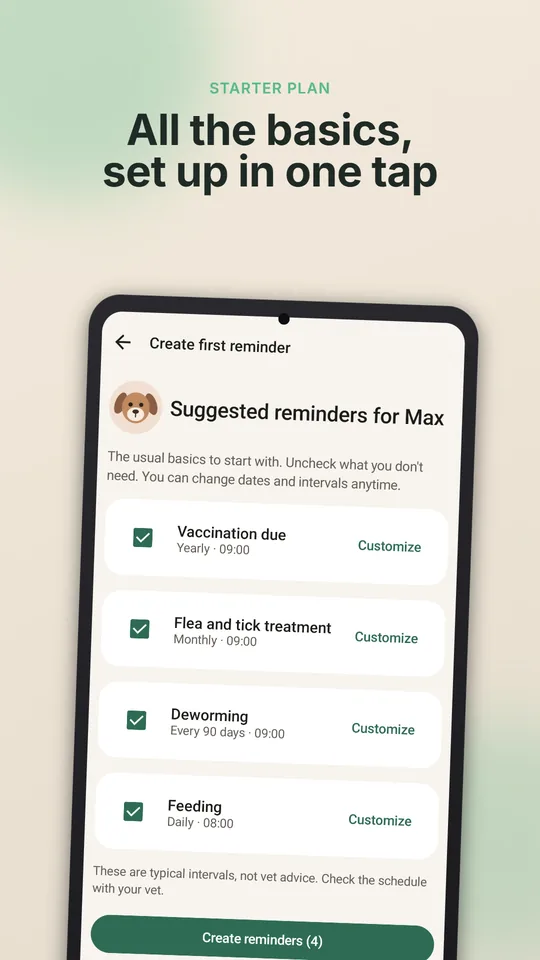
A scribbled weight on the fridge door is lost within a month. In PetCare Offline you can add a weight entry with a short note on appetite and body condition, set a monthly weigh-in reminder and see the trend over time, then create a PDF summary to give to your vet. It is a personal organizer, not a medical device, and your vet's advice always comes first. Related: dog feeding schedule by age and dog walk and exercise log.
Frequently asked questions
How can I weigh my dog at home without a pet scale?
For small dogs, put them in a carrier or box on a kitchen scale and subtract the container. For medium dogs you can weigh yourself with and without the dog on a bathroom scale and subtract, if you can lift them safely.
How do I weigh a large dog?
Use a floor scale at a vet clinic, groomer or pet shop, or a pet platform scale rated for the weight. Do not lift a dog you cannot hold safely.
How often should I weigh my dog?
Ask your vet; monthly is common for adults, weekly for young puppies, and as advised for seniors or dogs on a weight plan. Use the same scale and conditions each time.
How accurate is the carry-and-subtract method?
It is approximate. Bathroom scales usually read in 100 g steps, so the error is large for small dogs. Use a container on a kitchen scale for small dogs and a vet scale for important decisions.
How much weight change is a problem?
Unplanned changes of around 5 to 10 percent over weeks or months deserve attention, and sooner for puppies and small dogs. Always combine the number with body condition and appetite and ask your vet.
Is my dog overweight?
Check body condition: ribs should be easy to feel but not visible, with a waist from above and a belly tuck from the side. Ask your vet for a body condition score and a target weight.
Sources and further reading
How this article was created
This article was drafted with the help of artificial intelligence and edited against the app's published feature list. The independent developer is responsible for publication and accepts correction reports. Verify health, safety, legal, financial and official requirements with a primary source or qualified professional.
Questions and corrections: brightwaveapp@gmail.com. Legal and privacy information.