 PetCare
Activity
Dog Walk and Exercise Log: What to Record and Why
You know your dog walks every day, but could you say whether this month was more or less active than last? A short activity log turns a feeling into a fact, and that helps with weight, joint comfort, behaviour and vet visits.
What a log can tell you
- Weight problems: exercise and food together explain a trend on the scale. If weight creeps up while walks shrink, you can see why.
- Early stiffness: a dog that used to do a 40-minute walk and now turns for home after 20 is telling you something, gradually enough that you may not notice.
- Behaviour patterns: restless evenings often follow days with too little mental or physical exercise.
- Recovery after illness or surgery: your vet may prescribe a strict, gradually increasing walk plan; a log makes it easy to follow.
What to note
| Field | Example |
|---|---|
| Duration | 35 minutes |
| Type | Lead walk, off-lead run, swim, fetch, training |
| Intensity | Easy, steady, hard |
| Notes | Lagged behind on the hill; limped on the left hind leg after; very excited |
Two lines are enough. The notes field is the valuable part: a limp mentioned on three dates in a row is precisely what your vet wants to see.
How much exercise is right?
There is no single number. Needs depend on breed, age, fitness and health: a young working-breed dog may need a great deal more than a senior bulldog. Puppies should not be over-exercised while their joints are developing, so ask your vet about safe amounts for growing dogs. Use your log to find your own dog's normal and to see how your dog is after: pleasantly tired and settled is a good sign, while exhausted, limping or panting heavily for long afterwards is not.
Keep it easy
- Log right after the walk while the details are fresh.
- Use the same few types and intensity words so entries are comparable.
- Look at the week, not the day; a single short walk means nothing.
- Pair it with weight entries (see weight tracking) so effort and result sit side by side.
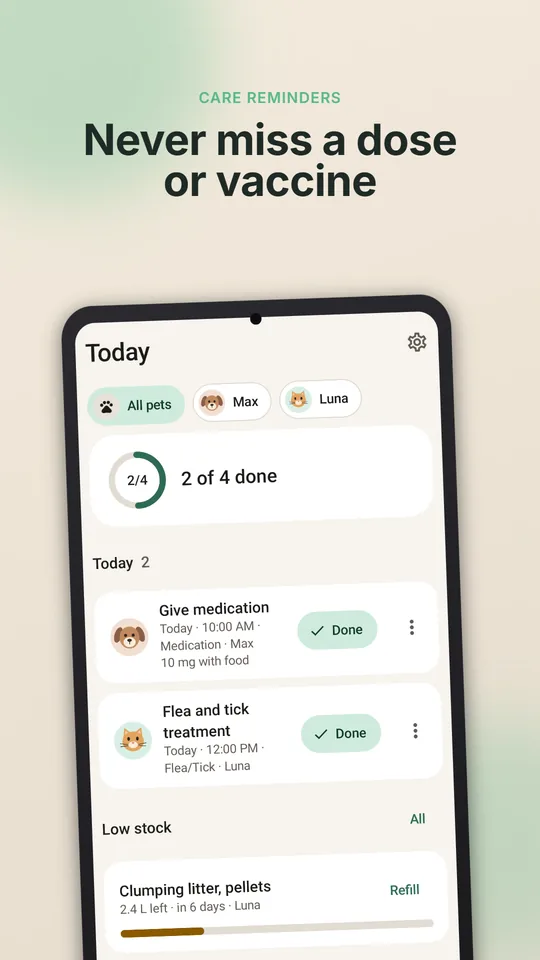
In PetCare Offline the activity log sits next to weight, symptoms, mood and custom notes on the dog's profile, and a PDF summary can go to your vet or dog walker. The data stays on your phone and works offline on trails without signal.
Walking in the heat? Note temperature in the log on hot days and shorten walks; see hot weather pet safety.
When to raise it with your vet
Reduced stamina lasting more than a week or two, coughing or laboured breathing on exercise, repeated limping, reluctance to jump or climb stairs, or a sudden change in energy level. Bring your log; it makes the conversation concrete.
Frequently asked questions
How long should I walk my dog each day?
It depends on breed, age, fitness and health, so there is no universal figure. Use your log to find your dog's normal and ask your vet for a target, especially for puppies and seniors.
Is a dog activity log useful for weight loss?
Yes. Recording exercise alongside food and regular weigh-ins shows what is working, so you can adjust with your vet's guidance.
Does a walk log need internet?
Not if you use an offline app. PetCare Offline stores logs on your device, so you can record a walk without signal.
Sources and further reading
How this article was created
This article was drafted with the help of artificial intelligence and edited against the app's published feature list. The independent developer is responsible for publication and accepts correction reports. Verify health, safety, legal, financial and official requirements with a primary source or qualified professional.
Questions and corrections: brightwaveapp@gmail.com. Legal and privacy information.