 PetCare
Feeding
What Time to Feed a Dog: Morning, Evening and Between
Most owners asking what time to feed a dog are really asking three things: how many hours apart the meals should be, whether the walk comes before or after the bowl, and how to fit all of it around a working day. There is no single correct clock time, but there are good reasons to pick certain times and then keep them.
The short answer
For a healthy adult dog, a common and sensible pattern is two meals a day, roughly 8 to 12 hours apart — for example around 7:00 in the morning and 18:00 or 19:00 in the evening. Puppies usually need more meals, some seniors and dogs with medical conditions need a vet-set plan, and a few dogs do well on three smaller meals. What matters most is not the exact hour but that the hours are predictable: dogs run on routine, and a dog who knows when food arrives is calmer around the kitchen, easier to take out at the right moment, and easier to read when appetite changes.
Your vet can override all of this for a specific dog. Treat the rest of this guide as a way to arrive at a sensible default and to understand the trade-offs, not as a prescription.
Why the time of day matters less than the spacing
A dog's stomach empties over several hours, and most healthy adults are comfortable with a gap of eight to twelve hours between meals. Going much longer, as with a single meal a day and a 24-hour gap, can leave some dogs hungry, nauseous or prone to vomiting yellow foam on an empty stomach in the early morning. Going much shorter, with meals only a few hours apart, usually means a dog who is being overfed or snacking too much.
So when you choose times, start with the gap, not the clock. If you leave for work at 7:30 and are back at 18:00, a breakfast at 6:45 and dinner at 18:30 gives a gap of about twelve hours overnight and eleven hours during the day. If you work shifts, anchor the meals to your own waking and returning, and let the dog's rhythm follow yours.
Sample schedules you can copy
| Your day | Meal 1 | Meal 2 | Notes |
|---|---|---|---|
| Standard office hours | 6:45–7:15 | 18:00–19:00 | Short toilet break after each meal; the main walk can go before the evening meal. |
| Work from home | 7:30–8:00 | 17:30–18:30 | Easiest case for dividing the day; resist an extra snack habit at the desk. |
| Early shift | 4:30–5:30 | 15:30–17:00 | Keep the same gap on days off, shifting by no more than half an hour. |
| Late or night shift | On waking, before you leave | After you get back, or earlier by a timer or a family member | Anchor to your pattern, not to the sun. |
| Three smaller meals | 7:00 | 13:00 and 19:00 | Used for some small breeds, puppies and dogs a vet has asked to eat more often. |
Walk before or after the meal?
There is no rule that suits every dog, but two points are widely agreed.
- Avoid hard exercise right around meals. A long run, ball chase or boisterous play session immediately before or after a large meal is a risk factor for stomach upset and, in large and deep-chested breeds, is one of the situations vets ask owners to avoid because of bloat (gastric dilatation-volvulus, GDV). Many vets suggest letting the dog rest quietly for an hour or so before and after a full meal. Ask your own vet how long applies to your dog, especially for a Great Dane, Weimaraner, Standard Poodle, German Shepherd or any other deep-chested breed.
- A short toilet break is fine. A calm sniff-and-do-your-business outing after a meal is different from vigorous activity, and puppies in particular need it.
In practice, a common routine is: get up, take the dog out, give a short calm walk, then feed breakfast after the dog has cooled down; in the evening, do the main walk first and feed afterwards once the dog has settled. Dogs who gulp food and then charge about often do better with a slow-feeder bowl and a calm half hour after eating.
Learn the bloat signs. Unproductive retching, a swollen or hard belly, restlessness, drooling and pale gums are an emergency in any dog, most of all large deep-chested breeds. Do not wait to see whether it passes: call an emergency clinic straight away.
Feeding around bedtime and the night
For puppies being toilet-trained, a common suggestion is to finish the last meal a few hours before bedtime and take the puppy out just before settling down, so the night is not interrupted as often. For adult dogs who wake early or vomit foam before breakfast, some vets suggest moving dinner a little later or adding a small portion from the daily allowance at bedtime — but that is a decision to make with your vet, because repeated morning vomiting can have other causes.
Do not give a large meal immediately before a long car journey, and avoid heavy feeding right before anaesthetic procedures: your vet will tell you whether to withhold food and for how long, and the instructions differ by procedure and by dog.
Timing when your dog takes medication
Many medications are given "with food" to reduce stomach upset, while others need an empty stomach. The instruction on the prescription label wins. If your dog takes medicine twice a day, it is simplest to tie it to the two meals — but check the label and ask your vet before doing that. Dogs with diabetes are a special case: the time and size of every meal is tied to insulin, and the schedule your vet sets should be followed closely. Write the times down so anyone covering for you can follow them exactly.
How to change a feeding time without a fuss
- Move by small steps. Shift each meal by 15 to 30 minutes every day or two until you reach the new time. Daylight-saving changes and new work hours are the usual reasons.
- Do not reward begging. If the dog starts nudging you an hour early, wait. Feeding earlier "just this once" teaches the new, earlier time.
- Keep the portion the same. Changing the time and the amount together makes it hard to tell what caused any upset.
- Allow a week. Most dogs adjust within a few days; stubborn ones take longer.
When the schedule goes wrong
- Dog skips meals. A healthy adult who occasionally leaves a meal on a hot day is usually fine. If a dog refuses food for more than a day, or a small dog or puppy refuses even one or two meals, call your vet — sooner if there is vomiting, diarrhoea, lethargy or any other sign of illness.
- Dog begs all day. Check the portion against the bag's guideline and body condition, count treats, and consider splitting the same daily amount into three smaller meals.
- Dog eats too fast. A slow-feeder bowl, a snuffle mat or scattering food in a puzzle toy slows the pace.
- More than one dog. Feed them at the same time but in separate spaces so there is no pressure or stealing, and keep each dog's bowl and portion consistent.
- Free-feeding. Leaving food out all day makes appetite changes hard to notice and often goes with weight gain; scheduled meals give you a clearer picture.
Write the schedule down
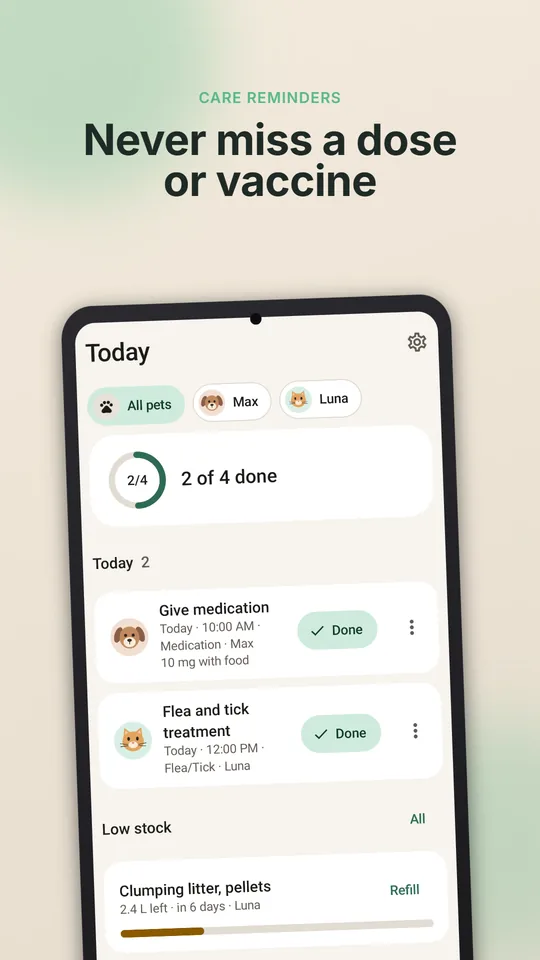
Most feeding problems on a real week come down to "who fed the dog, and when?" A schedule that lives only in your head breaks the first time someone else takes over. PetCare Offline has a feeding reminder type, so you can set the meal times once, tick each one off when it is done, and let family members or a sitter see the same routine. Add the food, the portion and any medication notes to the pet's profile, and keep it offline on your phone with no account. It is an organizer — your vet still decides what and how much your dog eats.
See also: the main dog feeding schedule guide, feeding schedules by age and lifestyle and weight tracking to check that the portions are working.
Frequently asked questions
What is the best time to feed a dog?
There is no single best clock time. A common pattern for healthy adult dogs is two meals a day, roughly 8 to 12 hours apart — for example 7:00 and 18:30 — kept the same every day. Consistency matters more than the exact hour.
How many hours apart should dog meals be?
For most healthy adults, around 8 to 12 hours is typical for two meals. Puppies, small breeds and dogs with medical needs often eat more frequently; your vet can set the right spacing.
Should I walk my dog before or after feeding?
A short toilet break is fine at any time, but avoid vigorous exercise immediately before or after a large meal, especially in large deep-chested breeds at risk of bloat. Many vets suggest resting for about an hour; ask your own vet how long applies to your dog.
Is it OK to feed my dog once a day?
Some dogs are fed once a day, but many do better with two meals. Longer gaps can leave some dogs hungry or vomiting foam on an empty stomach. If you are considering one meal a day, ask your vet first.
What time should I feed my dog at night?
Finish the last meal a few hours before bedtime so your dog can go out before settling, particularly for puppies in toilet training. If your dog vomits foam in the early morning, ask your vet whether a later dinner or a small bedtime portion would help.
How do I change my dog's feeding time?
Move each meal 15 to 30 minutes every day or two until you reach the new time, keep the portion the same and do not feed early when the dog begs.
Sources and further reading
How this article was created
This article was drafted with the help of artificial intelligence and edited against the app's published feature list. The independent developer is responsible for publication and accepts correction reports. Verify health, safety, legal, financial and official requirements with a primary source or qualified professional.
Questions and corrections: brightwaveapp@gmail.com. Legal and privacy information.