 PetCare
Dental care
How to Brush a Dog's or Cat's Teeth, Step by Step
Most dogs and cats develop some gum disease by early adulthood, and it is largely preventable. Brushing is the single most effective thing you can do at home, but only if your pet accepts it. This guide gives you a gentle two-week training plan, the technique, the products worth using, and the signs that mean a vet visit rather than a better toothbrush.
Why teeth need a routine
Plaque is a film of bacteria that forms on teeth within hours of eating. If it is not removed, it hardens into tartar, irritates the gums (gingivitis) and can progress to periodontal disease, which damages the tissue and bone that hold the teeth in place. Veterinary dental organisations commonly estimate that a large majority of dogs and cats show some degree of periodontal disease by around three years of age. Small breeds and flat-faced breeds are especially prone, and cats can also develop painful tooth resorption that is invisible to an owner.
Dental disease is not only about bad breath. It is painful, and pets hide pain well — a dog or cat with sore teeth often just eats a little more slowly, chews on one side or becomes grumpy about the face being touched. A daily routine, plus regular exams, is the best protection.
What you need
- Pet toothpaste. Use toothpaste made for dogs or cats, usually in poultry, beef or malt flavours. Never use human toothpaste: it can contain fluoride and, in some brands, xylitol, which are harmful to pets, and pets cannot spit.
- A brush the right size. A soft pet toothbrush, a child's soft brush or a finger brush. Small mouths need small heads. Choose whichever your pet tolerates best — a finger brush is often easiest to start with.
- Treats and patience. A tiny reward after each session helps the routine stick.
- A calm place and a good light. Your lap, a non-slip mat or a counter at a height that does not strain your back.
Look for products that carry the Veterinary Oral Health Council (VOHC) seal of acceptance, which means the manufacturer has shown the product slows plaque or tartar build-up. Brushing cannot be replaced by a flavoured treat.
A gentle two-week training plan
Do not begin by forcing a brush into the mouth. A calm introduction avoids a lifetime of struggling, and puppies and kittens, who learn it as a game, are the easiest to train. Adult and senior pets can learn too, just more slowly. Keep each session short — thirty seconds to two minutes — and stop while your pet is still relaxed.
| Days | Step | What to look for |
|---|---|---|
| 1–3 | Let your pet lick a little pet toothpaste from your finger. Repeat once or twice a day, then reward. | Eager licking: this is the taste you want associated with the routine. |
| 4–6 | Lift the lip gently and rub a toothpaste-covered finger along the outside of the front teeth and canines for a few seconds. | Relaxed jaw, no pulling away. If your pet backs off, go back a step. |
| 7–9 | Run your finger along the outer surfaces of the back teeth, where plaque builds up first, then reward. | Your pet allows touching the cheek teeth for 10–15 seconds. |
| 10–12 | Introduce the brush or finger brush with a little paste, still only on the outer surfaces. | Your pet looks at the brush with interest rather than avoidance. |
| 13–14 | Brush for 30 seconds each side, then finish with a treat. | Your pet is settled and tolerates the routine. |
If at any stage your pet is anxious, growls, snaps or you see the mouth is sore, stop and ask your vet to look at the teeth: a painful mouth makes every attempt fail.
The brushing technique
- Position yourself. Sit beside or slightly behind your pet; do not loom over the face. Hold the muzzle gently with your free hand.
- Lift the lip. You do not need to open the mouth wide. Work on the cheek-facing (outer) surfaces, which are where the plaque is, and the tongue side is largely self-cleaning.
- Angle the brush about 45 degrees to the gum line, so the bristles reach just under the edge of the gum.
- Use small circles or short back-and-forth strokes along the gum line, three or four teeth at a time, for roughly 30 seconds per side.
- Start at the back, where tartar forms fastest — the large upper cheek teeth beside the canine are the first to build up.
- Finish with a reward and then end the session with calm play or a walk.
Do not rinse. The pet toothpaste is made to be swallowed in small amounts.
Cats: use the same approach but with slower, shorter sessions, a very small finger brush and a salmon- or poultry-flavoured paste. Many cats accept the plan when it is introduced in kittenhood or after a meal when they are calm.
How often
Daily brushing is the standard recommendation because plaque re-forms within a day. If daily is not realistic, a less frequent routine is still better than none, but ask your vet what is a realistic plan for your individual pet and mouth. Pair the brushing with something you already do each day — before the evening meal, or after the last toilet trip — and add a reminder until it becomes habit.
Dental chews, diets and water additives
These can help as a supplement to brushing but are not a replacement for it. Look for the VOHC seal and check the chew size and calories (they count towards the daily allowance). Avoid hard objects that can fracture teeth: real bones, antlers, hooves, hard nylon bones and ice cubes for some dogs. As a rule of thumb, if you would not want to be hit on the knee with it, it is probably too hard to chew on. Supervise every chew and take away small remnants that could be swallowed.
Warning signs that need a vet, not a brush
- Persistent bad breath, especially a rotten or very strong smell.
- Red, swollen or bleeding gums; yellow-brown tartar along the gum line.
- Drooling, dropping food, chewing on one side or refusing hard food.
- Pawing at the mouth or rubbing the face on furniture.
- Loose, broken or discoloured teeth.
- Swelling on the face, especially below the eye, which can mean a tooth-root abscess.
- In cats: weight loss, drooling, red lines along the gums or reluctance to eat dry food.
Facial swelling, a mouth too sore to eat, or not eating for more than a day is a reason to call the clinic the same day.
Professional cleanings
Even with excellent home care, most pets need an examination and, when advised, a professional cleaning. A proper dental cleaning is done under general anaesthesia with scaling above and below the gum line, polishing and, ideally, dental X-rays, because most of the disease is below the gum line where you cannot see it. Veterinary dental organisations advise against so-called anaesthesia-free scaling because it cannot clean under the gums or assess the whole mouth, and can give a false sense of security. Ask your vet how often your pet needs a dental exam and discuss any pre-anaesthetic tests, particularly for older pets.
Track it so it sticks
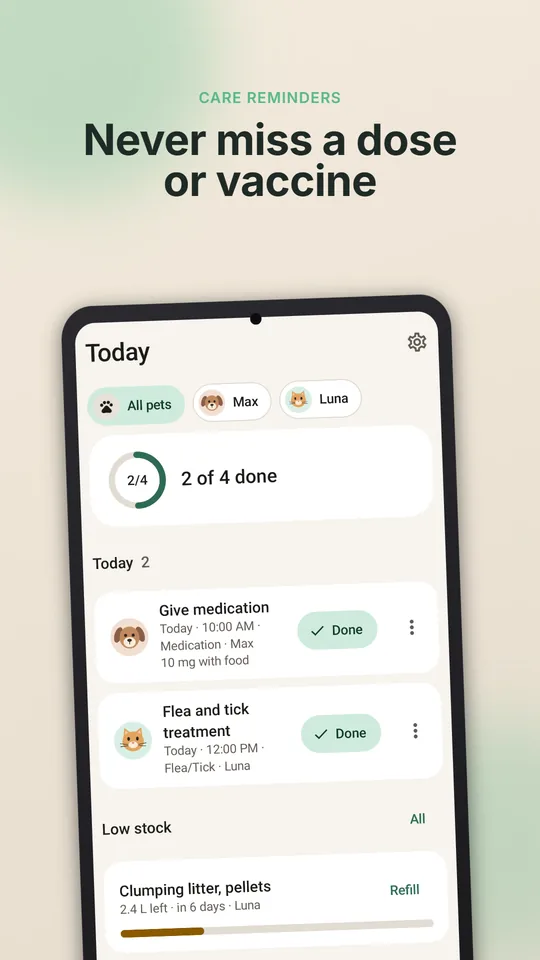
Routines die when they depend on memory. In PetCare Offline you can create a recurring reminder for brushing or a weekly mouth check, keep photos of the gum line in the pet's notes log so you can compare month to month and store the dental estimate or X-ray report as a document. When it is time for the next vet exam, create a PDF summary to show what you have been doing. Everything stays on your phone, with no account.
See also the pet dental care routine overview, grooming schedule and senior pet care.
Frequently asked questions
Can I use human toothpaste on my dog or cat?
No. Human toothpaste can contain fluoride and sometimes xylitol, both harmful to pets, and pets cannot spit. Use toothpaste made for dogs or cats.
How often should I brush my pet's teeth?
Daily brushing is the standard recommendation, because plaque re-forms within a day. If daily brushing is not realistic, ask your vet what routine is practical for your pet, but some brushing is better than none.
How do I get a pet used to tooth brushing?
Go slowly over about two weeks: let the pet lick the toothpaste, then touch the teeth and gums with a finger, then introduce a brush, with short sessions and a treat afterwards. Stop and go back a step if your pet becomes anxious.
Do dental chews replace brushing?
No. Chews and dental diets can help as a supplement, particularly products accepted by the Veterinary Oral Health Council, but brushing is the most effective home care. Avoid hard bones, antlers and hooves that can fracture teeth.
Are anaesthesia-free dental cleanings safe?
Veterinary dental organisations advise against them because scaling without anaesthesia cannot clean below the gum line or allow a full oral exam and X-rays, so disease can progress unnoticed.
What are the signs of dental disease in pets?
Bad breath, red or bleeding gums, tartar, drooling, dropping food, chewing on one side, pawing at the mouth, loose teeth or facial swelling. See a vet if you notice any of these.
Sources and further reading
How this article was created
This article was drafted with the help of artificial intelligence and edited against the app's published feature list. The independent developer is responsible for publication and accepts correction reports. Verify health, safety, legal, financial and official requirements with a primary source or qualified professional.
Questions and corrections: brightwaveapp@gmail.com. Legal and privacy information.